
Table of contents
Confusion of the two terminologies ‘medical billing’ and ‘medical coding’ as the same is perhaps the greatest misconception perpetuated in the field of medicine. If one were to ask someone with no clue what happens in the field of medicine about the perceptions he/she has regarding medical billing and coding, one would be sure to get the impression that both mean the same thing. But ask those in the field of medicine and one will come to a realization.
Medical billing and medical coding happen one right after the other during the course of the revenue cycle management process. They depend on each other so much but at the same time require expertise of their own kind. While some training and even some different professionals take care of the processes, it becomes easier to see why medical claims are often denied. Cueclaim offers all kinds of RCM services, medical billing and coding inclusive, with a good chance of success.
What Does a Medical Coder Actually Do?
This process involves a medical coder who decodes the documentation notes, records and tests produced by the physician, and codes them to describe both the disease and the procedure performed. This is a process that is much more clinical than people would expect considering the use of medical terms and documentation skills involved in coding the notes of the physician.
- Two coding systems are used by the coders, and knowing the difference between CPT codes and ICD-10 codes can be regarded as the first step in the process of coding.
- ICD-10 codes are the reason why the patient visited the physician; hence, they are the codes that represent the diagnosis of the patient’s chronic, acute diseases, or examinations.
- CPT codes are the procedures performed by the physician on the patient, including office visits, laboratory testing, and sometimes even minor surgeries.
It is the role of the coder to ensure that these two sets of codes are logical to each other because the lack of logic between diagnosis code and procedure code is one of the easiest ways of having your case reviewed by the payer.
What Does a Medical Biller Actually Do?
After the coding process has been completed, it is now time for the medical biller to come into play. It is now the responsibility of the biller to convert the coded information into claims, making sure that these are in compliance with the rules laid out by the payer, and then submit them through the clearinghouse electronically, whereby it is “scrubbed” by the clearinghouse and then forwarded to the insurance company.
As mentioned earlier, however, much of billing consists of tracking the status of the claim, noting payments made, and determining why the claims were denied or underpaid in order to re-submit the claim. The biller needs to have some information about the payer contracts and the reimbursement amounts to check whether or not there are discrepancies. Not all the money that the insurance company has agreed to pay out gets paid out properly.
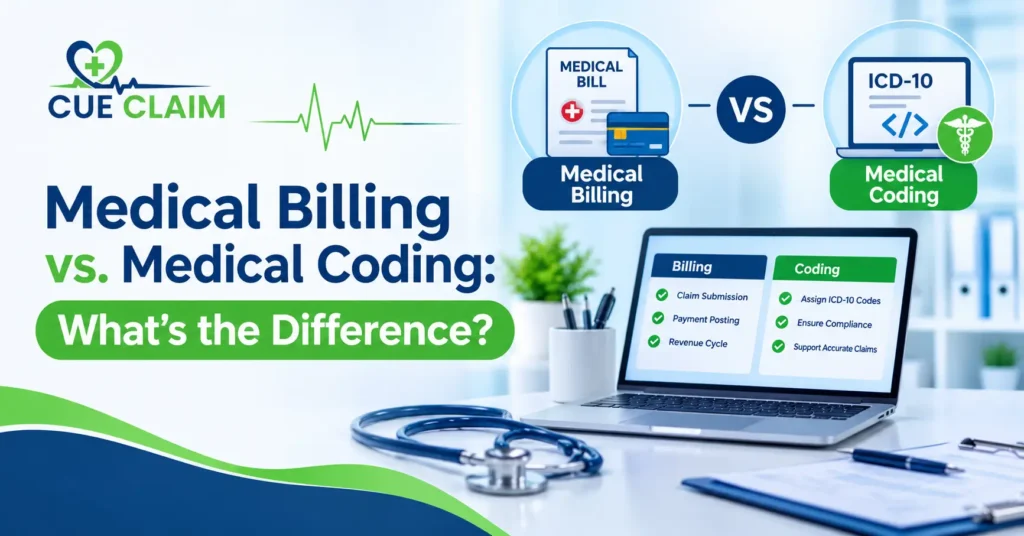
Medical Billing vs. Medical Coding
| Medical Coding | Medical Billing | |
| Core task | Translates diagnoses and procedures into standardized codes | Submits claims and manages payment follow-up |
| Key systems | ICD-10, CPT, HCPCS | Clearinghouses, payer portals, practice management software |
| Primary skill | Clinical documentation literacy | Insurance and payer process knowledge |
| Timing in the cycle | Happens after the visit, before the claim is created | Happens after coding is finalized |
| Main risk if done poorly | Denials from mismatched codes, compliance exposure | Delayed payment, lost revenue from unworked denials |
| Certification examples | CPC (Certified Professional Coder) | CPB (Certified Professional Biller) |
| Guiding question | “What happened during the visit?” | “How do we collect payment for it?” |
A Quick Real-World Example
For example, if the patient suffers from diabetes, and there is a need for a foot examination due to the condition of Type 2 Diabetes, the coder will assign the diagnosis code E11.9 as well as the CPT code 99213. Provided that the coder assigned the codes accurately and the relation is obvious, the whole procedure will be smooth for the patient.
However, if the coder assigns an ICD-10 code, which is not relevant for the visit or does not indicate the relation between the foot examination and diabetes diagnosis, then even though the biller submits a correctly filled claim, the insurance company will realize that there is a need for the medical necessity investigation and reject the claim. Thus, it will be up to the biller to solve the problem and submit the claim again. This is another example of how these processes cannot be separated from each other.
Do Practices Need Both Roles Separately?
The above shall largely be determined by the magnitude of the practice. Big practices as well as hospitals normally employ coders and billers separately owing to the high volume and complex nature of the claims. On the other hand, small practices usually combine these two roles into one due to the low volume that does not require two separate employees.
Most of the time, when practices decide to outsource revenue cycle management, they find themselves employing firms that combine the two services. This is owing to the fact that a majority of the nationwide medical billing companies offer coders and billers as one service. This is viewed as an advantage of outsourcing because they do not have to search for one person who combines the two skills.
The Bottom Line
Although these two terms may be confused at times, they both represent different professions altogether. While medical coding is a profession that involves giving codes to certain procedures, medical billing is the practice of converting these codes into payment. It could actually be important for you to distinguish one from the other so you can be able to identify the source of the problem.
Request a Professional Coding and Billing Evaluation
Book a free consultation and get a complimentary medical billing and medical coding audit. Cueclaim experts will review your claims to find out if there is a problem related to documentation or if the issue is related to claims follow-up and billing.
Frequently Asked Questions
Certainly, this is a practice in small firms, which demands a larger scope of training and experience than specialization in just one task. And as the number of claims increases, sooner or later most practices realize it is more effective to separate billing and coding or at least outsource them.
The role of billers who send claims and follow their status. Moreover, they appeal to insurance companies in case of claims’ rejection. Communication between insurance companies and coders is rare; however, the coder’s choice of codes greatly affects the response of the payer.
Both mistakes cost the firm money, but usually in different ways. Billing errors, such as lack of follow-up of rejected claims or lack of submitting a certain claim, can result in total loss of revenue, whereas the mistake of coding leads to delay of payment or compliance problems.
Although certification is not mandatory, it is required by most employers to be certified as a biller and coder.